Gedaan met laden. U bevindt zich op: FWO Nautcal botom. Comparison of numerical and experimental results for the hydrofoil case tested in water
FWO Nautcal botom. Comparison of numerical and experimental results for the hydrofoil case tested in water
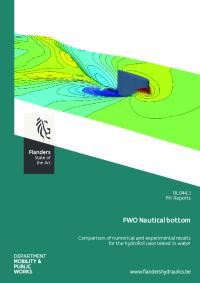
In the Fonds Wetenschappelijk Onderzoek (FWO) nautcal botom project, experiments have been executed with two objects in the inclined channel at Flanders Hydraulics (FH). The purpose of the experiments was to ob‐ tain validaton data for the Computatonal Fluid Dynamics (CFD) model that has been developed at KULeuven. In the frst test campaign, a cylinder was used and in the second one, a surface‐penetratng rudder was tested. For both cases, tests were frst executed where the tank was flled with water alone. Aferwards, tests are executed with mud and a combinaton of water and mud at diferent under‐keel clearances. In the current report, the experimental results obtained with the rudder setup in water are compared with CFD results obtained with FINE/Marine. The focus is on the lif and drag forces generated by the rudder in additon to the yawing moment. In the experiments, the rudder is tested at multple incidence angles between −10° and 10°. The computatons focus on a single incidence angle of −10° for speeds in the range V = 0.2 m/s to V = 1.2 m/s. Due to the relatvely low Reynolds numbers (which places the tests in the middle of the transiton from laminar to turbulent fow), the infuence of the turbulence closure model is tested as well: computatons are executed using pure laminar fow and fully turbulent fow. In additon, some computatons are executed with the simplifed one‐parameter transiton model available in FINE/Marine. All computatons are executed assuming steady fow conditons. Apart from the force comparison, pressure measured on the rudder is compared to the pressure feld obtained in CFD. The trends for the forces and pressure values as a functon of tow speed as measured in the experiments are captured in the numerical results, although some diferences remain. The one‐parameter transiton model is used without tuning and generates results that are situated between the fully laminar and fully turbulent results. The point pressure measurements on the rudder surface (in additon to the total forces and moments) are valuable for validaton purposes. Overall, the correspondence between experimental and numerical results is encouraging, but diferences remain. The case itself is however fairly complex, as at low speeds, both the turbulence model and tme integraton scheme infuence the results, while at high speeds, the high Froude numbers (and associated signifcant water surface deformatons) can be challenging for two‐phase solvers as well.
Lees de publicatie
- Publicatiedatum
- Augustus 2025
- Publicatietype
- Rapport
- Thema's
- Scheepvaart en havens
- Auteur(s)
- W. Van Hoydonck, M. Sotelo Zorrilla, S. López Castaño
- Reeks
- FH reports 18_044_1