From recycling champion to circular economy pioneer
How do we keep planet Earth liveable? By using our raw materials and energy much more efficiently. Flanders is a global pioneer in the transition to a circular economy.

Today Flanders is:
- no. 1 in Europe in recycling packaging waste
- no. 7 in circular materials use.
For the future, Flanders has:
- grand ambitions in six sectors
- a unique cooperation model of governments, businesses, civil society and the knowledge community working together
- closing circuits
- designing more sustainable products
- exploring new business models.
Circular construction

Circular construction means reusing materials to the maximum extent possible. But also ensuring that buildings last longer, for example, because they can easily be given new functions. Some examples.
The world’s first CO2-negative facing brick
Made in Flanders: the first CO2-negative facing brick. This brick absorbs more CO2 during production than it emits. The brick is composed of 80% residual streams from the steel industry.

Houses made of reusable ‘Lego’ blocks
Several manufacturers make facing bricks that are put together like Lego blocks, without using mortar or adhesive. For example, Facadeclick or ClickBrick.
Should we move that wall a bit?
You can easily rearrange offices thanks to customisable and modular interior walls. When customers no longer use the walls, they are bought back to give them a second, third, fourth, or even longer life.
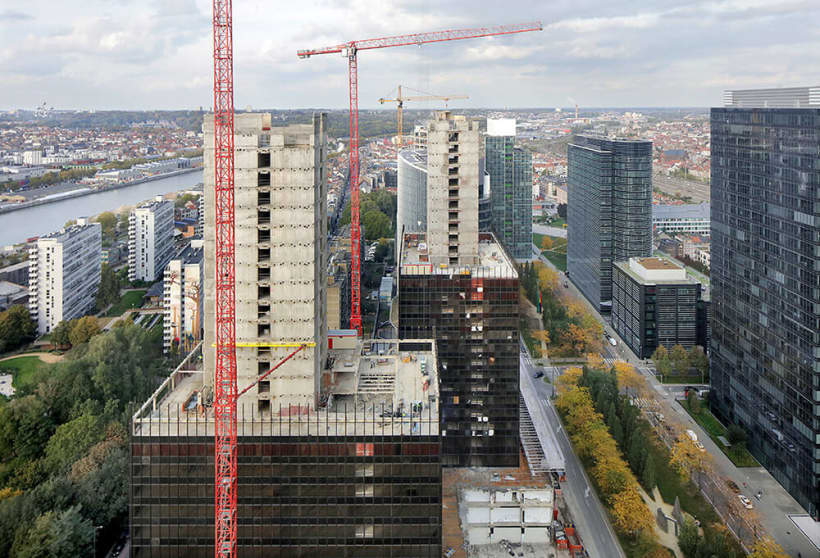
Full of life day and night
Sixty-five percent of the ‘new’ Marie-Elisabeth Belpaire building Marie-Elisabeth Belpairegebouw in Brussels consists of materials that were reused or recycled on site. There are offices on the odd floors and flats on the even floors. This way, there’s always life in the building and energy is used efficiently. Are more offices needed tomorrow than flats, or vice versa? Then these can be created quickly and easily.
The ZIN building, the larger complex of which Belpaire is a part, has been titled ‘World’s Best Tall Building 2025’ by the Council on Vertical Urbanism (CVU).
Bioeconomy

The biological cycle of the bioeconomy ensures a continuous supply of renewable raw materials.
Largest agri and biotech campus in Europe
Flanders offers a good breeding ground for the bioeconomy as the base of some of the most innovative biotechnology companies in the world. Ghent is home to Europe’s largest agri and biotech campus.

Hemp and co keep out the cold
Hemp is ideal for boards and insulation material. Green waste from cities and municipalities is converted into insulation batt made from grass. But wool, algae, mycelium, and even shells are already being used in Flanders for foundations, construction, insulation, etc.
Biomass hubs coordinate supply and demand
Networks such as Earth, Plant & Fibre connect different players in a value chain. Supply and demand are brought together in large biomass hubs (in Dutch).
Chemistry and plastics

Flanders is also well placed to become more circular in terms of chemistry and plastics.
Largest chemical cluster in Europe
Europe’s largest chemical cluster can be found in Antwerp. The high concentration of chemical companies, research establishments and sorting centres offers many innovation opportunities.
Startups, scale-ups and big players find each other
BlueChem is one of the first incubators for sustainable chemistry in Europe. Startups will find networking, support, and working and research space here. They can move on to scale-up locations such as the NextGen District.
Rapid evolution in the care sector
The care sector is progressing rapidly at the moment. Many players are making the switch to reuse, sterilisation or selective collection of plastics. This is how plastics from hospitals are processed into wall panels (in Dutch).

From waste to cleaning agent
The Ghent biotech company AmphiStar is working on a revolutionary technology platform that converts bio-based waste streams into biosurfactants. These sustainable surfactants can replace fossil raw materials and palm oil in products such as cleaning agents, cosmetics and agrichemicals.
The manufacturing industry

Flanders’s manufacturing industry is currently experiencing a great deal of pioneering activity. Over 50% of companies must operate in a more circular manner by 2030.
Circular and social
There is a lot of talent among people distant from the mainstream labour market. The 12 regional social-circular hubs in Flanders help circular enterprises find the perfect employees.

Fashion: eco-design and new business models
Many companies in Flanders are already pushing hard for eco-design in the fashion industry. And for new business models. Why not, for example, rent clothes instead of buying them? Or once again welcome the competencies (in Dutch) that people from other countries can teach us?
The food chain

We evolve towards a circular food chain by optimally using bioresources, food products and residual streams.
Unsold bread becomes beer
Flemish cuisine has a solid reputation. Chocolate, Belgian endives, North Sea shrimp and of course Beer. Our chefs like to experiment with circular techniques, for example using unsold bread to make beer or making a tasty snack from the leftover draff.
Restaurant serves leftovers
At Stoemp Deluxe (in Dutch), the menu depends on the residual streams available at the time from local (organic) farmers and supermarkets. Entropy also saves surplus food from going into the bin and turns it into nutritious meals.
Water cycles

Flanders is a region with few water resources. So it’s only logical that our expertise on water cycles is growing. .
Decentralised water purification keeps water on site
The Zwevegem-based company HelloWater developed a scalable, modular treatment plant with infinite application possibilities: in the stream, semi-underground, in clusters or freestanding, etc.

The system meets the most stringent discharge standards and even has a smaller carbon footprint than conventional public sewer networks. And, importantly, the water stays on site in such a decentralised system instead of being quickly drained through large watercourses.