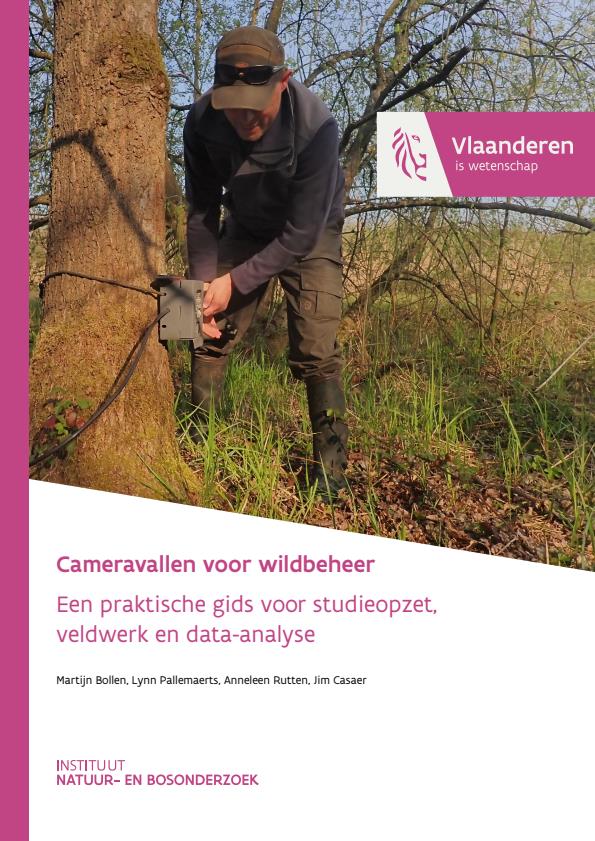
Cameravallen voor wildbeheer. Een praktische gids voor studieopzet, veldwerk en data-analyse
This report is a comprehensive guide to the use of camera traps. It focuses on the presence, distribution, activity patterns, population size and density of animal species. The aim is to assist researchers, wildlife managers and policymakers in setting up and analysing research using camera traps.
A large part of the report deals with statistical methods for analysing the collected data.
Finally, it provides practical guidelines for setting up a camera trap study. A general recommendation is to use at least 35 camera locations for a period of 3 to 5 weeks. For rare or shy species, a greater effort is required. A systematic arrangement in a grid pattern is ideal for estimating presence and density.
A large part of the report deals with statistical methods for analysing the collected data.
Finally, it provides practical guidelines for setting up a camera trap study. A general recommendation is to use at least 35 camera locations for a period of 3 to 5 weeks. For rare or shy species, a greater effort is required. A systematic arrangement in a grid pattern is ideal for estimating presence and density.
Details
| Number of pages | 141 |
|---|---|
| Type | Reports of Research Institute for Nature and Forest |
| Category | Research |
| Language | Dutch |
Bibtex
@book{566bfd0a-acb7-4ed3-bb64-e81fa35e794f,
title = "Cameravallen voor wildbeheer",
abstract = "This report is a comprehensive guide to the use of camera traps. It focuses on the presence, distribution, activity patterns, population size and density of animal species. The aim is to assist researchers, wildlife managers and policymakers in setting up and analysing research using camera traps.
A large part of the report deals with statistical methods for analysing the collected data.
Finally, it provides practical guidelines for setting up a camera trap study. A general recommendation is to use at least 35 camera locations for a period of 3 to 5 weeks. For rare or shy species, a greater effort is required. A systematic arrangement in a grid pattern is ideal for estimating presence and density.
",
author = "Martijn Bollen and Lynn Pallemaerts and Anneleen Rutten and Jim Casaer",
year = "2025",
month = jan,
day = "01",
doi = "10.21436/inbor.130153179",
language = "English",
publisher = "Instituut voor Natuur- en Bosonderzoek",
address = "Belgium",
}