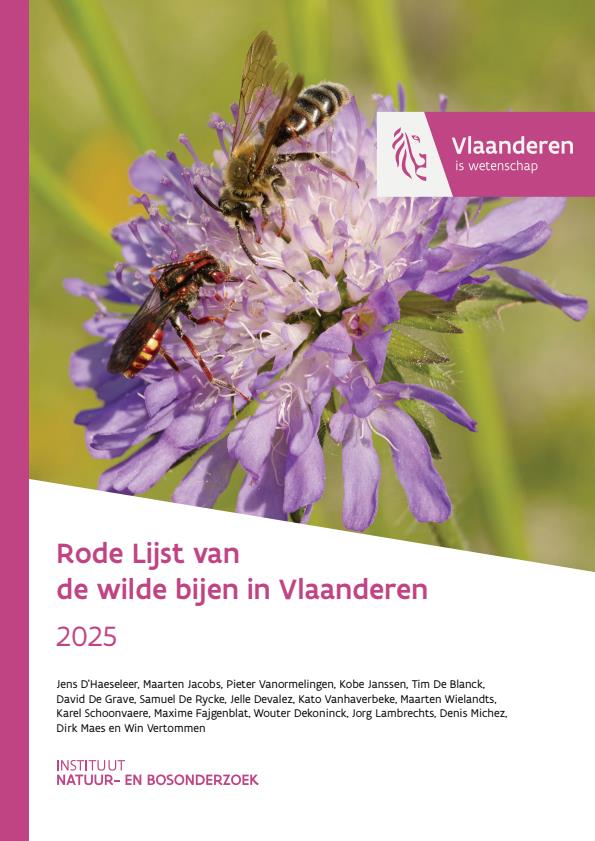
Rode Lijst van de wilde bijen in Vlaanderen 2025
Of the 340 species of wild bees in Flanders, 35 were found to be regionally extinct, 14 critically endangered, 37 endangered, 50 vulnerable, 40 near threatened and 148 least concern. For 16 species, there was insufficient information available to determine a Red List category.
An additional analysis showed that bumblebees, mining bees and sweet bees in particular have declined sharply, while masked bees have made significant gains. When we look at the trends per habitat preference, it appears that bees that thrive in urban environments are doing better. Bees from natural habitats such as heathland, forests, dunes and grasslands, on the other hand, have declined sharply. Above-ground nesting species generally increased. Underground nesting species, on the other hand, are not doing so well. Finally, it also appeared that species with a northern and continental distribution declined much more sharply than species with a more southern distribution. This has everything to do with climate change.
An additional analysis showed that bumblebees, mining bees and sweet bees in particular have declined sharply, while masked bees have made significant gains. When we look at the trends per habitat preference, it appears that bees that thrive in urban environments are doing better. Bees from natural habitats such as heathland, forests, dunes and grasslands, on the other hand, have declined sharply. Above-ground nesting species generally increased. Underground nesting species, on the other hand, are not doing so well. Finally, it also appeared that species with a northern and continental distribution declined much more sharply than species with a more southern distribution. This has everything to do with climate change.
Details
| Number of pages | 284 |
|---|---|
| Type | Reports of Research Institute for Nature and Forest |
| Category | Research |
| Language | Dutch |
Bibtex
@misc{085a9130-b2ae-43a9-9c4a-927d21cdff96,
title = "Rode Lijst van de wilde bijen in Vlaanderen 2025",
abstract = "Of the 340 species of wild bees in Flanders, 35 were found to be regionally extinct, 14 critically endangered, 37 endangered, 50 vulnerable, 40 near threatened and 148 least concern. For 16 species, there was insufficient information available to determine a Red List category.
An additional analysis showed that bumblebees, mining bees and sweet bees in particular have declined sharply, while masked bees have made significant gains. When we look at the trends per habitat preference, it appears that bees that thrive in urban environments are doing better. Bees from natural habitats such as heathland, forests, dunes and grasslands, on the other hand, have declined sharply. Above-ground nesting species generally increased. Underground nesting species, on the other hand, are not doing so well. Finally, it also appeared that species with a northern and continental distribution declined much more sharply than species with a more southern distribution. This has everything to do with climate change.
",
author = "J. D’Haeseleer and M. Jacobs and P. Vanormelingen and K. Janssen and T. De Blanck and D. De Grave and S. De Rycke and J. Devalez and K. Vanhaverbeke and M. Wielandts and K. Schoonvaere and M. Fajgenblat and W. Dekoninck and J. Lambrechts and D. Michez and Dirk Maes and W. Vertommen",
year = "2025",
month = jan,
day = "01",
doi = "https://doi.org/10.21436/inbor.124356263",
language = "English",
publisher = "Instituut voor Natuur- en Bosonderzoek",
address = "Belgium,
type = "Other"
}
Authors
J. D’HaeseleerM. Jacobs
P. Vanormelingen
K. Janssen
T. De Blanck
D. De Grave
S. De Rycke
J. Devalez
K. Vanhaverbeke
M. Wielandts
K. Schoonvaere
M. Fajgenblat
W. Dekoninck
J. Lambrechts
D. Michez
Dirk Maes
W. Vertommen