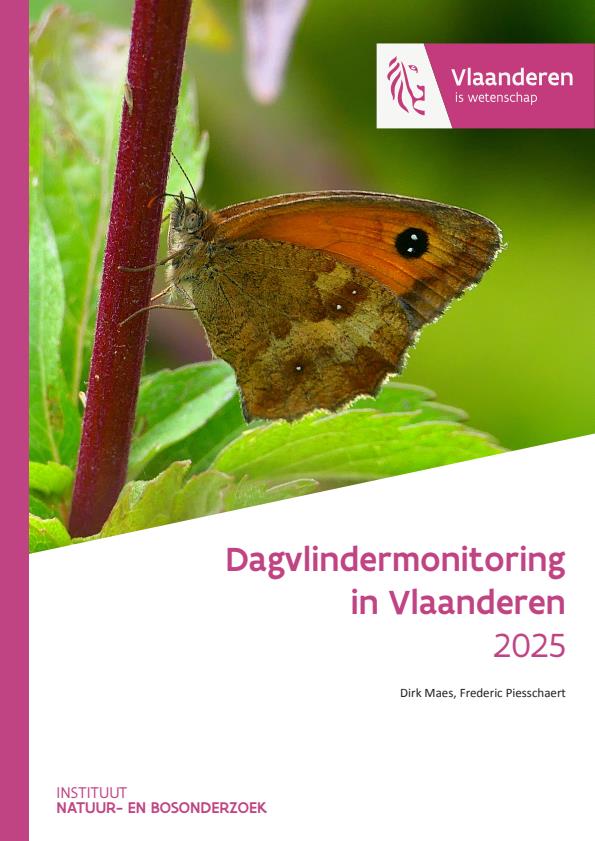
Dagvlindermonitoring in Vlaanderen 2025
In the period 1991–2025, we see:
- five clear losers: the large skipper, the small tortoiseshell, the ringlet, the Hedge brown and the Essex skipper
- three clear winners: the red admiral, the speckled wood and the common brimstone
- seven species that remain more or less stable, such as the European peacock and the orange tip
- six species with significant fluctuations, for example the holly blue and the common copper
Grassland butterflies are declining by an average of 58%. This is likely due to the decline of nutrient-poor, flower-rich grasslands caused by habitat loss and nitrogen deposition. Forest-related species increased sharply between 2000 and 2017, but have remained more or less stable since then.
- five clear losers: the large skipper, the small tortoiseshell, the ringlet, the Hedge brown and the Essex skipper
- three clear winners: the red admiral, the speckled wood and the common brimstone
- seven species that remain more or less stable, such as the European peacock and the orange tip
- six species with significant fluctuations, for example the holly blue and the common copper
Grassland butterflies are declining by an average of 58%. This is likely due to the decline of nutrient-poor, flower-rich grasslands caused by habitat loss and nitrogen deposition. Forest-related species increased sharply between 2000 and 2017, but have remained more or less stable since then.
Details
| Number of pages | 29 |
|---|---|
| Type | Reports of Research Institute for Nature and Forest |
| Category | Research |
| Language | Dutch |
Bibtex
@book{18c0fe57-7efc-4392-92c2-0addb93415a9,
title = "Dagvlindermonitoring in Vlaanderen 2025",
abstract = "In the period 1991–2025, we see:
- five clear losers: the large skipper, the small tortoiseshell, the ringlet, the Hedge brown and the Essex skipper
- three clear winners: the red admiral, the speckled wood and the common brimstone
- seven species that remain more or less stable, such as the European peacock and the orange tip
- six species with significant fluctuations, for example the holly blue and the common copper
Grassland butterflies are declining by an average of 58%. This is likely due to the decline of nutrient-poor, flower-rich grasslands caused by habitat loss and nitrogen deposition. Forest-related species increased sharply between 2000 and 2017, but have remained more or less stable since then.",
author = "Dirk Maes and Frederic Piesschaert",
year = "2026",
month = jan,
day = "01",
doi = "10.21436/inbor.141313554",
language = "English",
publisher = "Instituut voor Natuur- en Bosonderzoek",
address = "Belgium",
}