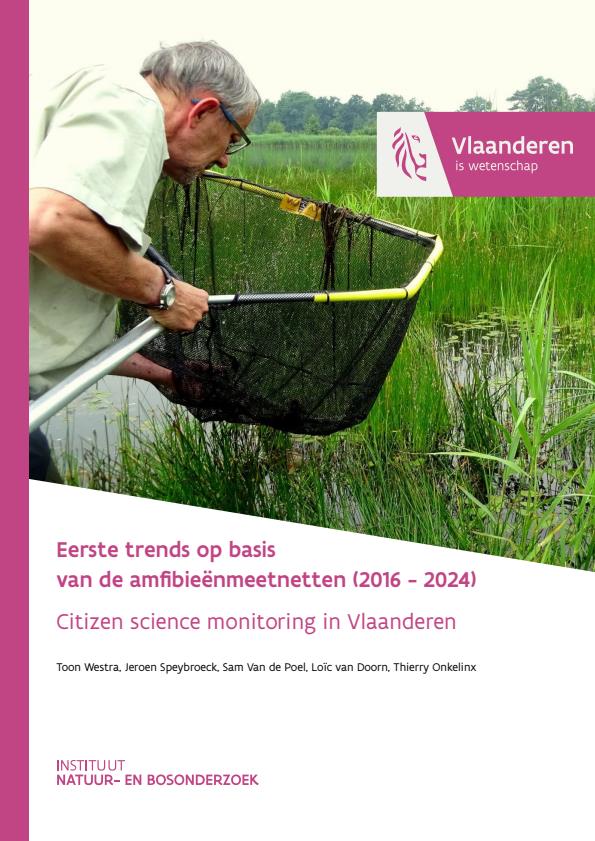
Eerste trends op basis van de amfibieënmeetnetten (2016 - 2024). Citizen science monitoring in Vlaanderen
In the period 2016-2024, we see:
- a strong increase in midwife toad, fire salamander and natterjack toad. The increase in midwife toad can largely be explained by the release of bred animals as part of the species protection programme. Further monitoring is needed to determine whether this increase is sustainable. The natterjack toad is a pioneer species that naturally exhibits strong fluctuations. For the time being, we are seeing a strong increase, but a longer time series is needed to gain a better understanding of the trend.
- an increase in tree frogs
- no clear trend for crested newts and common spadefoots. Common spadefoots only occurs in a few places in Flanders, and its conservation status remains very unfavourable. In the coming years, targeted monitoring will reveal if the release of captive‐bred individuals is succesfull.
Moor frogs and pool frogs are difficult to count, so we need to further refine the monitoring protocol. Only then will we be able to report trends.
- a strong increase in midwife toad, fire salamander and natterjack toad. The increase in midwife toad can largely be explained by the release of bred animals as part of the species protection programme. Further monitoring is needed to determine whether this increase is sustainable. The natterjack toad is a pioneer species that naturally exhibits strong fluctuations. For the time being, we are seeing a strong increase, but a longer time series is needed to gain a better understanding of the trend.
- an increase in tree frogs
- no clear trend for crested newts and common spadefoots. Common spadefoots only occurs in a few places in Flanders, and its conservation status remains very unfavourable. In the coming years, targeted monitoring will reveal if the release of captive‐bred individuals is succesfull.
Moor frogs and pool frogs are difficult to count, so we need to further refine the monitoring protocol. Only then will we be able to report trends.
Details
| Number of pages | 54 |
|---|---|
| Type | Reports of Research Institute for Nature and Forest |
| Category | Research |
| Language | Dutch |
Bibtex
@misc{09cc91ae-d164-4a9c-84fd-8cb571e4c01b,
title = "Eerste trends op basis van de amfibieënmeetnetten (2016 - 2024)",
abstract = "In the period 2016-2024, we see:
- a strong increase in midwife toad, fire salamander and natterjack toad. The increase in midwife toad can largely be explained by the release of bred animals as part of the species protection programme. Further monitoring is needed to determine whether this increase is sustainable. The natterjack toad is a pioneer species that naturally exhibits strong fluctuations. For the time being, we are seeing a strong increase, but a longer time series is needed to gain a better understanding of the trend.
- an increase in tree frogs
- no clear trend for crested newts and common spadefoots. Common spadefoots only occurs in a few places in Flanders, and its conservation status remains very unfavourable. In the coming years, targeted monitoring will reveal if the release of captive‐bred individuals is succesfull.
Moor frogs and pool frogs are difficult to count, so we need to further refine the monitoring protocol. Only then will we be able to report trends.",
author = "Toon Westra and Jeroen Speybroeck and Sam Van de Poel and Loïc van Doorn and Thierry Onkelinx",
year = "2025",
month = jan,
day = "01",
doi = "https://doi.org/10.21436/inbor.125529462",
language = "English",
publisher = "Instituut voor Natuur- en Bosonderzoek",
address = "Belgium,
type = "Other"
}