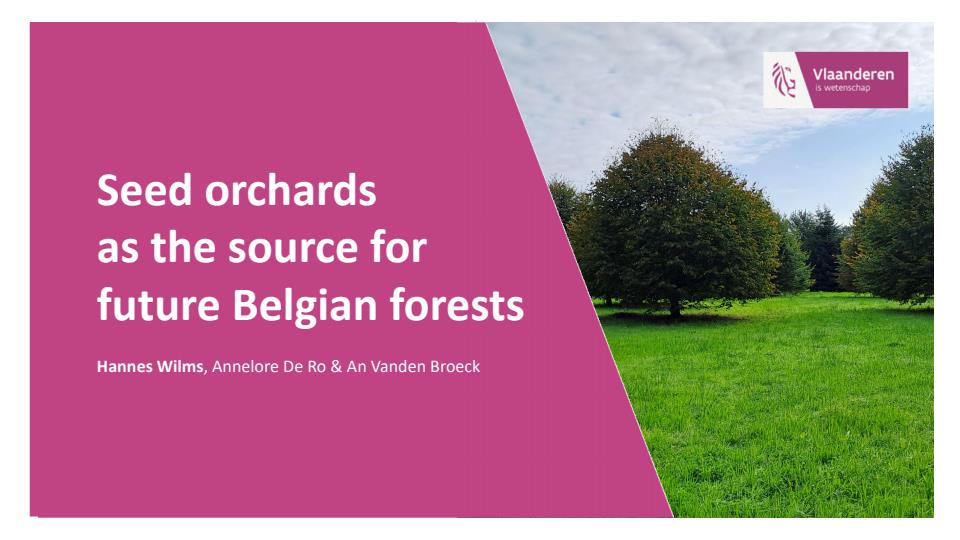
Seed orchards as the source for future Belgian forests
In Europe the trade of forest reproductive material (FRM) of certain tree species which are often used for wood production are regulated via a European directive. This directive has been adapted to local legislation by the regional Flemish government and certifies both the quality and provenance of the FRM. In addition to the species mentioned in the European directive, the Flemish government also included certain shrub- and tree species which are important to the forest ecosystem in the local legislation. Via the quality label ‘plant van hier’ (plant from here) the Flemish government promotes the use of FRM that originates from within the region in plantings. Aiming to create locally adapted plantings that will grow into more diverse and resilient forests. However, an important bottleneck is the availability of certified material. To source this material, the institute for forest and nature research (INBO) and the agency for forest and nature (ANB) have set up seed orchards in the past where this material is cultivated. Whilst the orchards were initially productive, over the years different problems started occurring, causing there be a low supply for certain species. For example in some of the seed orchards diseases and pest started appearing, whilst in others plants had grown so much that they couldn’t be easily harvested. To get an overview of all problems INBO, ANB and the forest tree nursery sector collaborated on a project to increase the supply of autochthonous FRM. During this project we first evaluated different seed orchards, after which we recommended certain actions to increase their productivity and the quality of the FRM. We also tested and used different propagation methods to duplicate material from existing orchards. This material was then used to establish new seed orchards together with our project partners.
Details
| Number of pages | 19 |
|---|---|
| Type | Paper/Powerpoint/Abstract |
| Category | Research |
| Language | English |
Bibtex
@misc{d67a8066-eb80-4ec8-b2f5-36407b5bd7de,
title = "Seed orchards as the source for future Belgian forests",
abstract = "In Europe the trade of forest reproductive material (FRM) of certain tree species which are often used for wood production are regulated via a European directive. This directive has been adapted to local legislation by the regional Flemish government and certifies both the quality and provenance of the FRM. In addition to the species mentioned in the European directive, the Flemish government also included certain shrub- and tree species which are important to the forest ecosystem in the local legislation. Via the quality label ‘plant van hier’ (plant from here) the Flemish government promotes the use of FRM that originates from within the region in plantings. Aiming to create locally adapted plantings that will grow into more diverse and resilient forests. However, an important bottleneck is the availability of certified material. To source this material, the institute for forest and nature research (INBO) and the agency for forest and nature (ANB) have set up seed orchards in the past where this material is cultivated. Whilst the orchards were initially productive, over the years different problems started occurring, causing there be a low supply for certain species. For example in some of the seed orchards diseases and pest started appearing, whilst in others plants had grown so much that they couldn’t be easily harvested. To get an overview of all problems INBO, ANB and the forest tree nursery sector collaborated on a project to increase the supply of autochthonous FRM. During this project we first evaluated different seed orchards, after which we recommended certain actions to increase their productivity and the quality of the FRM. We also tested and used different propagation methods to duplicate material from existing orchards. This material was then used to establish new seed orchards together with our project partners.",
author = "Hannes Wilms and Annelore De Ro and An Vanden Broeck",
year = "2025",
month = nov,
day = "07",
doi = "",
language = "English",
publisher = "Instituut voor Natuur- en Bosonderzoek",
address = "Belgium,
type = "Other"
}