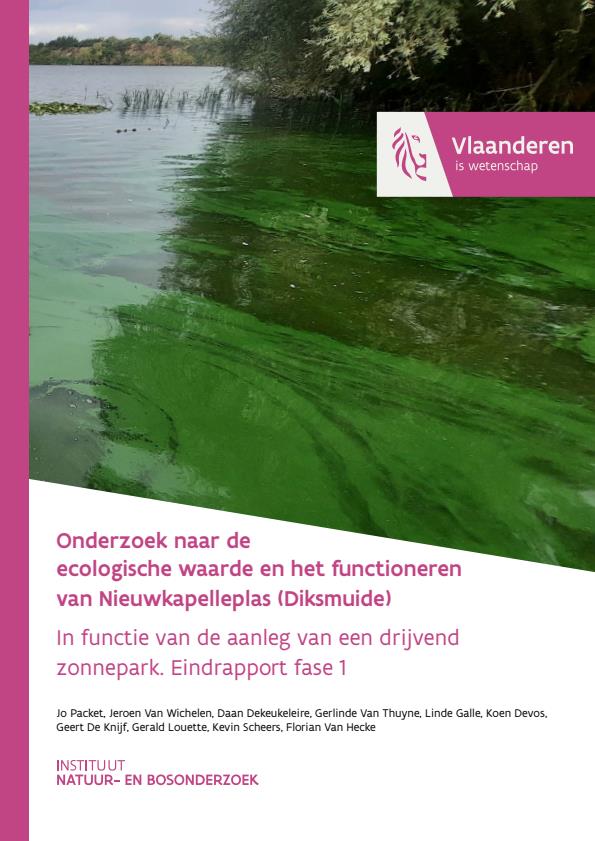
Onderzoek naar de ecologische waarde en het functioneren van Nieuwkapelleplas (Diksmuide) in functie van de aanleg van een drijvend zonnepark. Eindrapport fase 1
De Watergroep wants to construct a floating solar park on the Nieuwkapelleplas. A two-phase study has been launched to measure the impact of this project. Phase 1, the results of which are contained in this report, investigates the ecological condition of the lake prior to installation. Phase 2 will evaluate the effects after installation.
The Nieuwkapelleplas is a deep, alkaline, and nutrient-rich lake covering 7.8 hectares. Water quality, stratification, phyto- and zooplankton, plants, birds, dragonflies, bats, and fish were studied monthly, divided into a solar park zone and a peripheral zone.
The water quality is poor: the lake is heavily eutrophicated, with high concentrations of phosphorus and nitrogen, leading to frequent algal blooms, especially of potentially toxic cyanobacteria. This results in limited visibility and oxygen-depleted zones in summer. Biodiversity scores for vegetation, fish, and phytoplankton are inadequate to poor.
Although there were no systematic differences between the edge and solar park zones in terms of water quality and plankton, dragonflies, birds, and bats mainly use the shoreline zone and the adjacent open water, which is important for their habitat. The presence of the spined loach and the absence of invasive fish species are positive.
The Nieuwkapelleplas is a deep, alkaline, and nutrient-rich lake covering 7.8 hectares. Water quality, stratification, phyto- and zooplankton, plants, birds, dragonflies, bats, and fish were studied monthly, divided into a solar park zone and a peripheral zone.
The water quality is poor: the lake is heavily eutrophicated, with high concentrations of phosphorus and nitrogen, leading to frequent algal blooms, especially of potentially toxic cyanobacteria. This results in limited visibility and oxygen-depleted zones in summer. Biodiversity scores for vegetation, fish, and phytoplankton are inadequate to poor.
Although there were no systematic differences between the edge and solar park zones in terms of water quality and plankton, dragonflies, birds, and bats mainly use the shoreline zone and the adjacent open water, which is important for their habitat. The presence of the spined loach and the absence of invasive fish species are positive.
Details
| Number of pages | 111 |
|---|---|
| Type | Reports of Research Institute for Nature and Forest |
| Category | Research |
| Language | Dutch |
Bibtex
@misc{23a6135f-00d4-4136-97c6-ae19bb518b5d,
title = "Onderzoek naar de ecologische waarde en het functioneren van Nieuwkapelleplas (Diksmuide) in functie van de aanleg van een drijvend zonnepark. Eindrapport fase 1",
abstract = "De Watergroep wants to construct a floating solar park on the Nieuwkapelleplas. A two-phase study has been launched to measure the impact of this project. Phase 1, the results of which are contained in this report, investigates the ecological condition of the lake prior to installation. Phase 2 will evaluate the effects after installation.
The Nieuwkapelleplas is a deep, alkaline, and nutrient-rich lake covering 7.8 hectares. Water quality, stratification, phyto- and zooplankton, plants, birds, dragonflies, bats, and fish were studied monthly, divided into a solar park zone and a peripheral zone.
The water quality is poor: the lake is heavily eutrophicated, with high concentrations of phosphorus and nitrogen, leading to frequent algal blooms, especially of potentially toxic cyanobacteria. This results in limited visibility and oxygen-depleted zones in summer. Biodiversity scores for vegetation, fish, and phytoplankton are inadequate to poor.
Although there were no systematic differences between the edge and solar park zones in terms of water quality and plankton, dragonflies, birds, and bats mainly use the shoreline zone and the adjacent open water, which is important for their habitat. The presence of the spined loach and the absence of invasive fish species are positive.",
author = "Jo Packet and Jeroen Van Wichelen and Daan Dekeukeleire and Gerlinde Van Thuyne and Linde Galle and Koenraad Devos and Geert De Knijf and Gerald Louette and Kevin Scheers and Florian Van Hecke",
year = "2025",
month = jan,
day = "01",
doi = "https://doi.org/10.21436/inbor.118022605",
language = "English",
publisher = "Instituut voor Natuur- en Bosonderzoek",
address = "Belgium,
type = "Other"
}