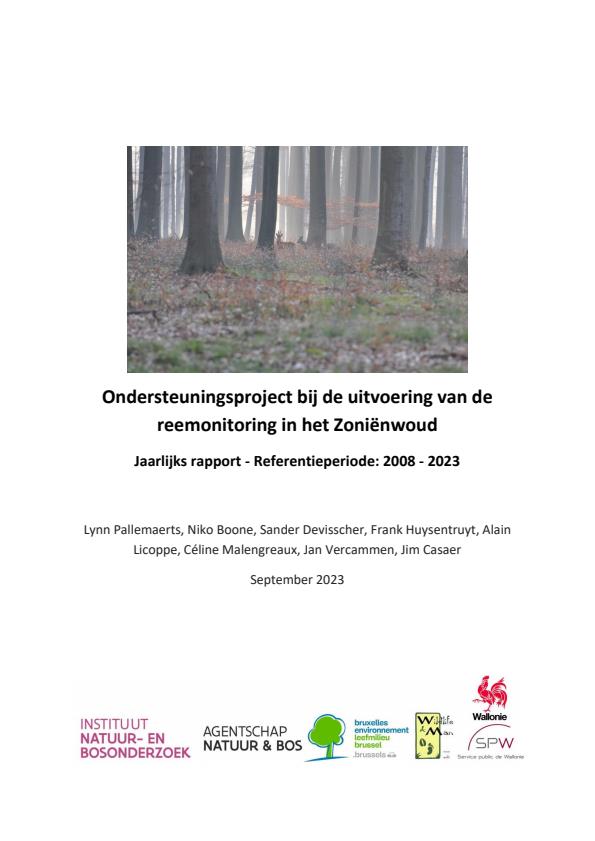
Ondersteuningsproject bij de uitvoering van de reemonitoring in het Zoniënwoud. Jaarlijks rapport - Referentieperiode: 2008 - 2023
After the decline in the average kilometre index we observed in 2014, 2015 and 2016, the population seemed to stabilise at a lower level. While the average KI hovered around 1 roe/km from 2008 to 2013, the index never exceeded 0.75 since 2014. Since 2017, the KI dropped below 0.6. Even the value for 2021, with an average of 0.5, is again on the low side compared to the figures since 2014, so the decline still seems to be continuing. In 2016, we cited that the declining figures may indicate a decline in the roe deer population in the Sonian Forest.
Since there is no evidence that the detection probability has decreased, especially in the period 2015-2021, it seems plausible to assume a declining population of roe deer in the Sonian Forest. A detailed and integrated analysis of sightings, distances and visibility measurements seems appropriate to look for any spatial differences throughout the area.
This information could help identify the causes of the decline so that measures can be tested to halt and, if possible, reverse it.
Since there is no evidence that the detection probability has decreased, especially in the period 2015-2021, it seems plausible to assume a declining population of roe deer in the Sonian Forest. A detailed and integrated analysis of sightings, distances and visibility measurements seems appropriate to look for any spatial differences throughout the area.
This information could help identify the causes of the decline so that measures can be tested to halt and, if possible, reverse it.
Details
| Number of pages | 27 |
|---|---|
| Type | Reports of Research Institute for Nature and Forest |
| Category | Research |
| Language | Dutch |
Bibtex
@misc{16502814-1e0e-4777-809e-2ebe3191a40b,
title = "Ondersteuningsproject bij de uitvoering van de reemonitoring in het Zoniënwoud. Jaarlijks rapport - Referentieperiode: 2008 - 2023",
abstract = "After the decline in the average kilometre index we observed in 2014, 2015 and 2016, the population seemed to stabilise at a lower level. While the average KI hovered around 1 roe/km from 2008 to 2013, the index never exceeded 0.75 since 2014. Since 2017, the KI dropped below 0.6. Even the value for 2021, with an average of 0.5, is again on the low side compared to the figures since 2014, so the decline still seems to be continuing. In 2016, we cited that the declining figures may indicate a decline in the roe deer population in the Sonian Forest.
Since there is no evidence that the detection probability has decreased, especially in the period 2015-2021, it seems plausible to assume a declining population of roe deer in the Sonian Forest. A detailed and integrated analysis of sightings, distances and visibility measurements seems appropriate to look for any spatial differences throughout the area.
This information could help identify the causes of the decline so that measures can be tested to halt and, if possible, reverse it.",
author = "Lynn Pallemaerts and Niko Boone and Sander Devisscher and Frank Huysentruyt and Alain Licoppe and Céline Malengreaux and Jan Vercammen and Jim Casaer",
year = "2023",
month = jan,
day = "01",
doi = "https://doi.org/10.21436/inbor.97794585",
language = "English",
publisher = "Instituut voor Natuur- en Bosonderzoek",
address = "Belgium,
type = "Other"
}
Authors
Lynn PallemaertsNiko Boone
Sander Devisscher
Frank Huysentruyt
Alain Licoppe
Céline Malengreaux
Jan Vercammen
Jim Casaer