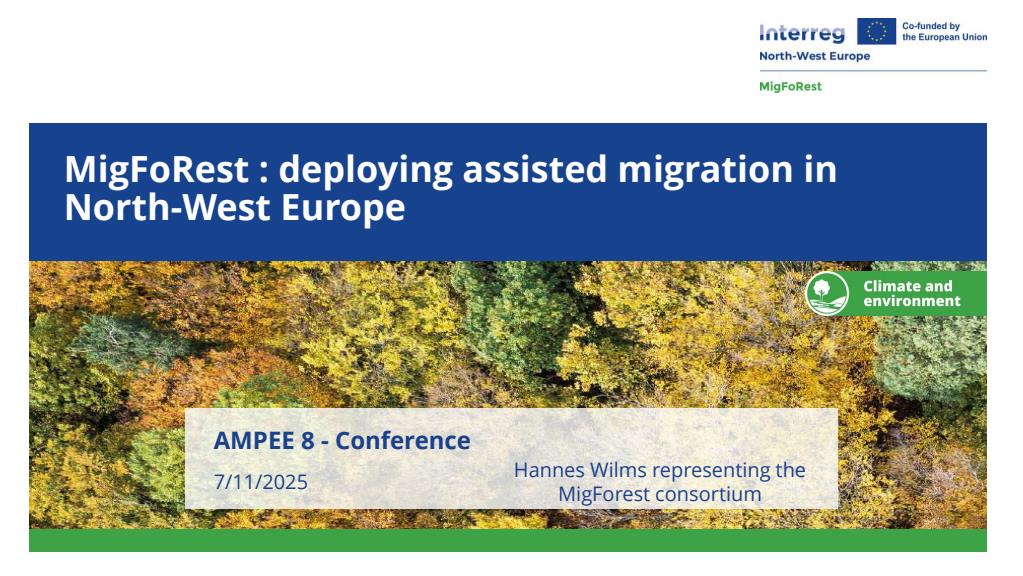
MigFoRest: deploying assisted migration in North-West Europe
Climate change is challenging and impacting Belgian forests, as temperatures increase and extreme weather events are likely to increase. One method to make our forest more resilient is the implementation of assisted migration (AM). This approach involves the relocation of species or genetic material to areas where they are more likely to thrive under future climate conditions. The Interreg project MigFoRest is a collaborative effort between Belgium, Germany, and France which aims to bring assisted migration into practice across multiple forest regions. The goal is to enhance forest resilience by increasing both the species diversity and the genetic variation within local forests. To perform AM, the project first identifies connectivity nodes-key locations in the landscape where interventions can have the most impact. These are selected using detailed inventories that assess functional biodiversity, current and projected climatic suitability for different species, and their spatial distribution. Within these locations, the project establishes enrichment cells: targeted plots where European tree species and provenances are planted that are able to withstand present and future climate conditions, and are able to cross with local provenances to create offspring that is both adapted to local circumstances and climate proof. What distinguishes MigFoRest is its large-scale strategy combined with its innovative use of assisted migration to enhance the resilience and ecological connectivity of forests across North-West Europe.
Details
| Aantal pagina's | 15 |
|---|---|
| Type | Paper/Powerpoint/Abstract |
| Categorie | Onderzoek |
| Taal | Engels |
Bibtex
@misc{8333f271-9773-45c1-be3f-81ab9642c2db,
title = "MigFoRest: deploying assisted migration in North-West Europe",
abstract = "Climate change is challenging and impacting Belgian forests, as temperatures increase and extreme weather events are likely to increase. One method to make our forest more resilient is the implementation of assisted migration (AM). This approach involves the relocation of species or genetic material to areas where they are more likely to thrive under future climate conditions. The Interreg project MigFoRest is a collaborative effort between Belgium, Germany, and France which aims to bring assisted migration into practice across multiple forest regions. The goal is to enhance forest resilience by increasing both the species diversity and the genetic variation within local forests. To perform AM, the project first identifies connectivity nodes-key locations in the landscape where interventions can have the most impact. These are selected using detailed inventories that assess functional biodiversity, current and projected climatic suitability for different species, and their spatial distribution. Within these locations, the project establishes enrichment cells: targeted plots where European tree species and provenances are planted that are able to withstand present and future climate conditions, and are able to cross with local provenances to create offspring that is both adapted to local circumstances and climate proof. What distinguishes MigFoRest is its large-scale strategy combined with its innovative use of assisted migration to enhance the resilience and ecological connectivity of forests across North-West Europe. ",
author = "Hannes Wilms and Lola Badalamenti and Silvija Bilela-Eckert and Aurélien Blond and Vincent Boulanger and Nicolas Dassonville and Annelore De Ro and Bram D'hondt and Diane Doucet and Aikaterini Dounavi and Sophie Dufour and Olivier Fabes and Manuel Karopka and Maxime Lambinet and Olivier Leflon and Bénédicte Leguerroue and David Mathy and Brigitte Musch and Charalambos Neophytou and An Vanden Broeck and Margot Vanhellemont",
year = "2025",
month = nov,
day = "07",
doi = "",
language = "Nederlands",
publisher = "Instituut voor Natuur- en Bosonderzoek",
address = "België,
type = "Other"
}
Auteurs
Hannes WilmsLola Badalamenti
Silvija Bilela-Eckert
Aurélien Blond
Vincent Boulanger
Nicolas Dassonville
Annelore De Ro
Bram D'hondt
Diane Doucet
Aikaterini Dounavi
Sophie Dufour
Olivier Fabes
Manuel Karopka
Maxime Lambinet
Olivier Leflon
Bénédicte Leguerroue
David Mathy
Brigitte Musch
Charalambos Neophytou
An Vanden Broeck
Margot Vanhellemont