Early detection of IAS in Flanders. From centralised reporting to effective early warning
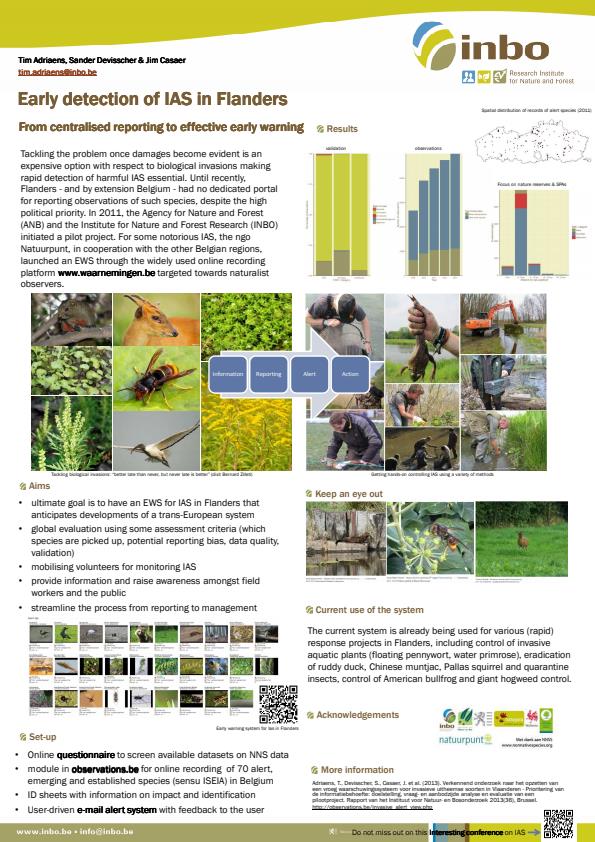
Tackling the problem once damages become evident is an expensive option with respect to biological invasions. Therefore, rapid detection of potentially harmful IAS is essential. Until recently, Flanders - and by extension Belgium - had no dedicated portal for reporting observations of such species, despite the high political priority and ongoing current (inter)national initiatives. In 2011, the Agency for Nature and Forest and the Institute for Nature and Forest Research initiated a pilot. For some notorious IAS, the ngo Natuurpunt, ANB and INBO, in cooperation with the other Belgian regions, lanched an EWS through the widely used online recording platform www.waarnemingen.be targeted towards naturalist observers. It allows for reporting sightings, consulting fact sheets and setting up user-driven automated e-mail alerts. The aim of the pilot phase (March-November 2012) was to examine how the system could work (which species are picked up, potential reporting bias, data quality). Apart from testing the reporting tool as an EWS, the project had several spin-offs. In the longer run, we aimed at mobilising volunteers for monitoring IAS, to provide information and raise awareness amongst field workers and the public and to streamline the process from reporting to management intervention. The ultimate goal is to have an EWS for IAS in Flanders, that connects with federal initiatives and anticipates developments of a trans-European system. The current system is already being used for various response projects in Flanders, including control of invasive aquatic plants, ruddy duck, Pallas squirrel, quarantine insects, American bullfrog, giant hogweed and Chinese muntjac.
Details
| Aantal pagina's | 1 |
|---|---|
| Type | Poster |
| Categorie | Onderzoek |
| Taal | Engels |
Bibtex
@misc{c0b654ff-104f-4556-b608-1e3c6f454ba0,
title = "Early detection of IAS in Flanders",
abstract = "Tackling the problem once damages become evident is an expensive option with respect to biological invasions. Therefore, rapid detection of potentially harmful IAS is essential. Until recently, Flanders - and by extension Belgium - had no dedicated portal for reporting observations of such species, despite the high political priority and ongoing current (inter)national initiatives. In 2011, the Agency for Nature and Forest and the Institute for Nature and Forest Research initiated a pilot. For some notorious IAS, the ngo Natuurpunt, ANB and INBO, in cooperation with the other Belgian regions, lanched an EWS through the widely used online recording platform www.waarnemingen.be targeted towards naturalist observers. It allows for reporting sightings, consulting fact sheets and setting up user-driven automated e-mail alerts. The aim of the pilot phase (March-November 2012) was to examine how the system could work (which species are picked up, potential reporting bias, data quality). Apart from testing the reporting tool as an EWS, the project had several spin-offs. In the longer run, we aimed at mobilising volunteers for monitoring IAS, to provide information and raise awareness amongst field workers and the public and to streamline the process from reporting to management intervention. The ultimate goal is to have an EWS for IAS in Flanders, that connects with federal initiatives and anticipates developments of a trans-European system. The current system is already being used for various response projects in Flanders, including control of invasive aquatic plants, ruddy duck, Pallas squirrel, quarantine insects, American bullfrog, giant hogweed and Chinese muntjac.",
author = "Tim Adriaens and Sander Devisscher and Jim Casaer",
year = "2014",
month = apr,
day = "02",
doi = "",
language = "Nederlands",
publisher = "Instituut voor Natuur- en Bosonderzoek",
address = "België",
type = "Other"
}