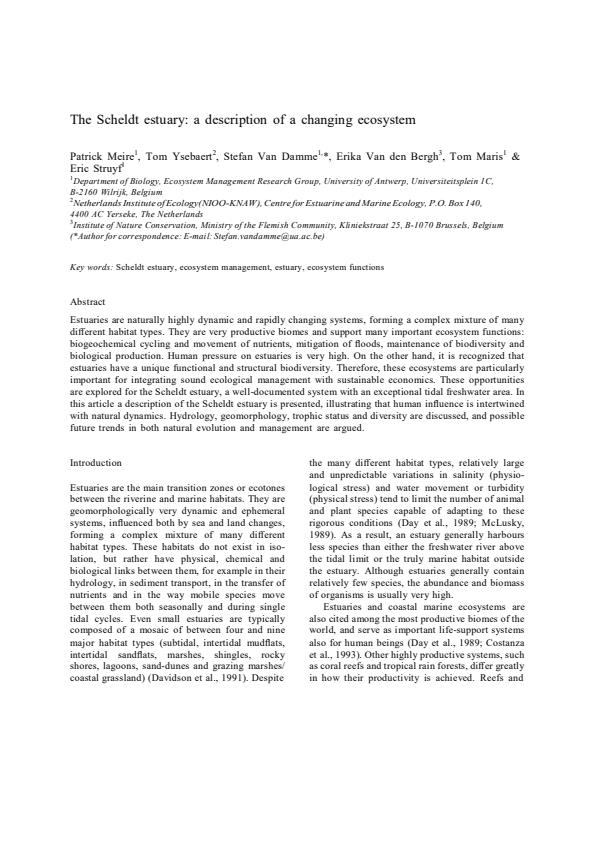
The Scheldt estuary. A description of a changing ecosystem
Estuaries are naturally highly dynamic and rapidly changing systems, forming a complex mixture of many different habitat types. They are very productive biomes and support many important ecosystem functions: biogeochemical cycling and movement of nutrients, mitigation of floods, maintenance of biodiversity and biological production. Human pressure on estuaries is very high. On the other hand, it is recognized that estuaries have a unique functional and structural biodiversity. Therefore, these ecosystems are particularly important for integrating sound ecological management with sustainable economics. These opportunities are explored for the Scheldt estuary, a well-documented system with an exceptional tidal freshwater area. In this article a description of the Scheldt estuary is presented, illustrating that human influence is intertwined with natural dynamics. Hydrology, geomorphology, trophic status and diversity are discussed, and possible future trends in both natural evolution and management are argued.
Details
| Aantal pagina's | 11 |
|---|---|
| Volume | 540 |
| Tijdschrift nummer | 1-3 |
| Pagina's (van-tot) | 1-11 |
| Type | A1: Web of Science-artikel |
| Categorie | Onderzoek |
| Tijdschrift | Hydrobiologia|Hydrobiologia online |
| Issns | 0018-8158 |
| Uitgeverij | Springer Science+Business Media |
| Taal | Engels |
Bibtex
@misc{b207804f-a840-4734-a313-fd08c6ac0f78,
title = "The Scheldt estuary",
abstract = "Estuaries are naturally highly dynamic and rapidly changing systems, forming a complex mixture of many different habitat types. They are very productive biomes and support many important ecosystem functions: biogeochemical cycling and movement of nutrients, mitigation of floods, maintenance of biodiversity and biological production. Human pressure on estuaries is very high. On the other hand, it is recognized that estuaries have a unique functional and structural biodiversity. Therefore, these ecosystems are particularly important for integrating sound ecological management with sustainable economics. These opportunities are explored for the Scheldt estuary, a well-documented system with an exceptional tidal freshwater area. In this article a description of the Scheldt estuary is presented, illustrating that human influence is intertwined with natural dynamics. Hydrology, geomorphology, trophic status and diversity are discussed, and possible future trends in both natural evolution and management are argued.",
author = "Patrick Meire and Tom Ysebaert and S Van Damme and Erika Van den Bergh and T Maris and E Struyf",
year = "2005",
month = jan,
day = "01",
doi = "https://doi.org/10.1007/s10750-005-0896-8",
language = "Nederlands",
publisher = "Springer Science+Business Media",
address = "België,
type = "Other"
}