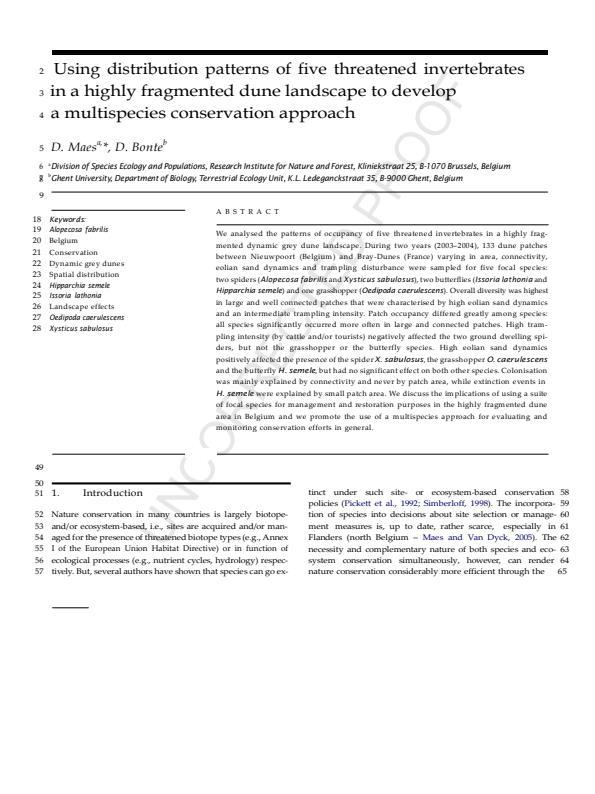
Using distribution patterns of five threatened invertebrates in a highly fragmented dune landscape to develop a multispecies conservation approach
We analysed the patterns of occupancy of five threatened invertebrates in a highly fragmented dynamic grey dune landscape. During two years (2003–2004), 133 dune patches between Nieuwpoort (Belgium) and Bray-Dunes (France) varying in area, connectivity, eolian sand dynamics and trampling disturbance were sampled for five focal species: two spiders (Alopecosa fabrilis and Xysticus sabulosus), two butterflies (Issoria lathonia and Hipparchia semele) and one grasshopper (Oedipoda caerulescens). Overall diversity was highest in large and well connected patches that were characterised by high eolian sand dynamics and an intermediate trampling intensity. Patch occupancy differed greatly among species: all species significantly occurred more often in large and connected patches. High trampling intensity (by cattle and/or tourists) negatively affected the two ground dwelling spiders, but not the grasshopper or the butterfly species. High eolian sand dynamics positively affected the presence of the spider X. sabulosus, the grasshopper O. caerulescens and the butterfly H. semele, but had no significant effect on both other species. Colonisation was mainly explained by connectivity and never by patch area, while extinction events in H. semele were explained by small patch area. We discuss the implications of using a suite of focal species for management and restoration purposes in the highly fragmented dune area in Belgium and we promote the use of a multispecies approach for evaluating and monitoring conservation efforts in general.
Details
| Aantal pagina's | 10 |
|---|---|
| Volume | 133 |
| Tijdschrift nummer | 4 |
| Pagina's (van-tot) | 490-499 |
| Type | A1: Web of Science-artikel |
| Categorie | Onderzoek |
| Tijdschrift | Biological Conservation |
| Issns | 0006-3207|1873-2917 |
| Uitgeverij | Applied Science Publishers |
| Taal | Engels |
Bibtex
@misc{8e6d536f-8d95-43d2-b733-c6e9a1849e7d,
title = "Using distribution patterns of five threatened invertebrates in a highly fragmented dune landscape to develop a multispecies conservation approach",
abstract = "We analysed the patterns of occupancy of five threatened invertebrates in a highly fragmented dynamic grey dune landscape. During two years (2003–2004), 133 dune patches between Nieuwpoort (Belgium) and Bray-Dunes (France) varying in area, connectivity, eolian sand dynamics and trampling disturbance were sampled for five focal species: two spiders (Alopecosa fabrilis and Xysticus sabulosus), two butterflies (Issoria lathonia and Hipparchia semele) and one grasshopper (Oedipoda caerulescens). Overall diversity was highest in large and well connected patches that were characterised by high eolian sand dynamics and an intermediate trampling intensity. Patch occupancy differed greatly among species: all species significantly occurred more often in large and connected patches. High trampling intensity (by cattle and/or tourists) negatively affected the two ground dwelling spiders, but not the grasshopper or the butterfly species. High eolian sand dynamics positively affected the presence of the spider X. sabulosus, the grasshopper O. caerulescens and the butterfly H. semele, but had no significant effect on both other species. Colonisation was mainly explained by connectivity and never by patch area, while extinction events in H. semele were explained by small patch area. We discuss the implications of using a suite of focal species for management and restoration purposes in the highly fragmented dune area in Belgium and we promote the use of a multispecies approach for evaluating and monitoring conservation efforts in general.",
author = "Dirk Maes and D Bonte",
year = "2006",
month = jan,
day = "01",
doi = "https://doi.org/10.1016/j.biocon.2006.08.001",
language = "Nederlands",
publisher = "Applied Science Publishers",
address = "België,
type = "Other"
}